
Neural tube disorders
Neural tube disorders (NTDs) generally arise from incomplete closer of the neural tube. The symptoms differ depending on the type of neural tube defect that has occurred. The three most common types are spina bifida, anencephaly and encephalocele. Neural tube defects have an incidence of 1-2 per 1000 births.
Spins bifida
Is the most common type of neural tube defect with The Spina Bifida Association of America (SBAA) estimating that more than 70,000 people in the United States are living with spina bifida. It occurs during early pregnancy and there are three common forms. Occulta is the mildest form often with only a small defect in closure. Meningocele is the rarest where the meniges protrude out of the spinal cord. Myelomeningocele is the most severe form in which the mininges and spinal cord protrude through an opening in the spinal cord. In the later two cases surgey can be used to move the meninges back inside the spinal cord however varying levels of nervous damage may already have occurred. 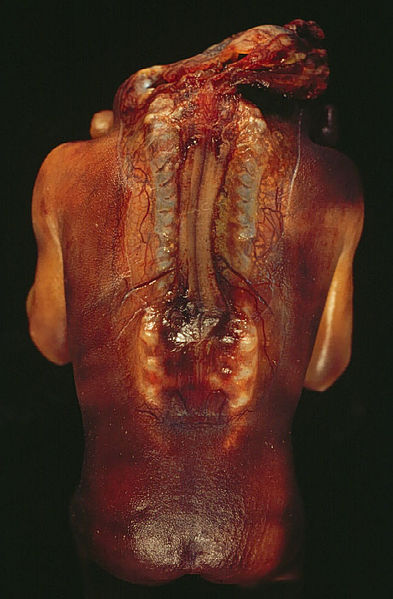
Anencephaly
Failure of closure of the cephalic region of the neural tube leads to loss of the forebrain and cerebrum. A large proportion of babies with anencephaly are still born and those that aren’t have no consciousness and survive only a few hours
Encephaloceles
Is the rarest type of disorder with portions of brain tissue protruding through openings in the skull. Many other abnormalities in the brain and skull can also occur including paralysis of the limbs, visual dysfunction, retardation and hydrocephalus. Prognosis varies depending on the amount and type of protrusion, surgery can help in some cases.
Image courtesy of wikicommons this image is in the public domain and thus free of any copyright restrictions
Risk factors and prevention
The occurrence of neural tube disorders varies depending on multiple factors, which include
· Race
· Geographical location
· Nutritional status
· Genetic factors
There has been some evidence to suggest that the preconceptional use of clomiphene by mothers suffering from infertility and follicular cysts can lead to an increase in the prevalence of NTDs. A definite link has not been established but the possibility that reproductive technology may increase NTDs needs further exploration. A proven link does exsist between a preconceptional folic acid (vitamin B9) defficancy and NTDs. Approximatly 70% of NTDs are folic acid sensitive and it is now recommended that any prospective mother should consume 4mg/day of folic acid prior to conception and continue taking it into their first trimester. The American College of Medical Genetics recommends that folic acid should be taken in the form of supplement / multivitamin / fortified in food. In addition to folic acid low maternal serum levels of vitamin B12 have been associated with a higher risk of NTDs. It has been shown that 34% of all NTDs in Canada may be attributable to B12 deficiencies leading to the suggestion that food should be fortified with
 B12 as well as folic acid. High levels of folic acid can mask a low vitamin B12 phenotype highlighting the importance of ensuring adequate B12 levels before conception. Single nucleotide polymorphisms (SNPs) have been shown to influence both maternal and fetal folic acid levels as well as altered nucleotide biosynthesis and impaird cellular methylation all of which can result in defective
neural tube closure. A family history of NTDs or maternal diabetes also increases the risk of conceiving a child with NTDs. In summary there are several types of NTD and it is vital that any women trying to conceive consumes an adequate amount of folic acid. If NTDs have occurred in a previous pregnancy then approaching a clinician to asses both maternal and fetal risk factors may help reduce the incidence of prenatal NTDs.
Image courtesy of wikicommons under creative commons license
Search site
Did you know?
Folic acid might help to prevent some other birth defects, such as cleft lip and palate and some heart defects.